Mold exposure health risks in Charleston homes: what's real and what's overblown
By Priya Tan · Updated 2026-06-03

Mold has a reputation that outpaces what happens to most people who’re exposed to it. That doesn’t mean it’s nothing. It means the real risk depends heavily on who you are and how long the exposure has gone on.
This is general health information, not medical advice. If you or someone in your home has ongoing symptoms you suspect are related to mold, talk to a doctor about your specific situation.
What actually happens to most people
For someone without underlying respiratory issues, mold exposure typically causes irritant or allergic-type symptoms: nasal congestion, throat irritation, coughing, watery eyes, or mild skin irritation on contact. These symptoms usually show up with ongoing exposure in an affected space and ease once you’re away from it or the mold is removed. This is uncomfortable, not dangerous, for most healthy adults.
Who’s actually at higher risk
The picture changes for a smaller group of people:
- Anyone with asthma or existing mold or dust allergies, who may see genuinely worse symptoms, not just discomfort.
- People with a compromised immune system, where mold exposure carries a higher chance of a more serious reaction.
- Infants, young children, and older adults, who tend to be more sensitive to irritants generally.
If someone in the home falls into one of these groups, it’s worth treating a mold problem as more urgent, not because the mold itself is more toxic to them, but because their margin for an irritant reaction becoming something worse is thinner.
| Group | Typical risk level |
|---|---|
| Healthy adult, no allergies | Low: irritant symptoms if exposure is heavy or prolonged |
| Adult with asthma or mold allergy | Moderate to higher: real symptom flare-ups are common |
| Immunocompromised individual | Higher: talk to a doctor about any household mold |
| Infant, young child, or older adult | Higher sensitivity to irritant effects generally |
Where the “toxic mold” fear comes from, and where it overshoots
Certain mold species, black mold among them, get described as producing dangerous toxins that poison a house. The more grounded version of that story: some mold species can produce compounds of concern under lab conditions, but for a typical resident in a typical exposure, the dominant health effects are allergic and irritant reactions, not toxic poisoning. Finding a mold species with a scary name is less important than how much of it there is and how long it’s been growing.
A simple way to judge urgency
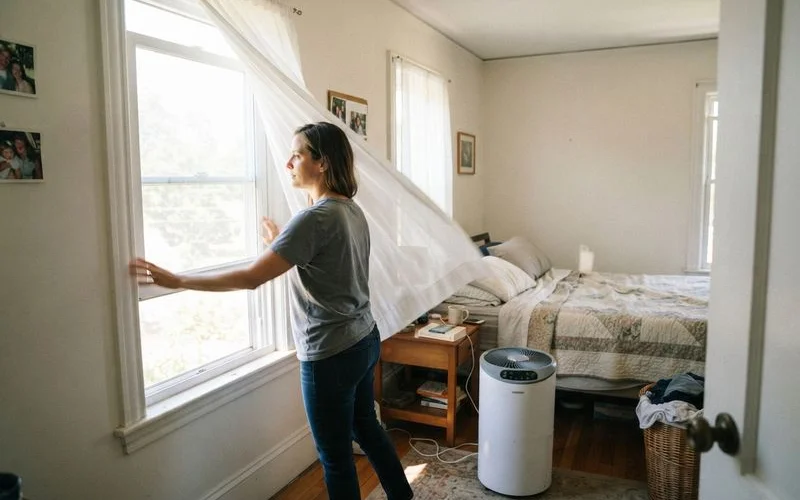
Two questions tell you most of what you need to know. First, do symptoms track with time spent in the space, better when away, worse when back? Second, does anyone in the home fall into a higher-risk group? If either answer points toward a real pattern, it’s worth having the space inspected rather than waiting to see if it resolves on its own. A pattern like that can also mean the growth is somewhere you can’t see; the hidden mold in HVAC systems and walls guide covers what to check when nothing is visible.
Why Charleston’s climate raises the baseline
Humidity does more than make a house feel sticky. It keeps building materials closer to the moisture level mold needs to keep growing, even without an obvious leak. That means the same small water event that might dry out and stop causing problems in a drier climate can keep feeding growth here for weeks. It’s part of why local remediation crews treat the moisture source, not just the visible mold, as the actual job.
When to stop waiting and act
A musty smell with no visible growth is worth an inspection, not a fire drill. Visible growth larger than a small patch, a moisture event that went unaddressed for more than a day or two, or symptoms that clearly track with time in a specific room are the signals worth acting on. Charleston’s humidity means small moisture problems don’t stay small for long, so addressing a real one early tends to be cheaper and simpler than waiting.
Compare local mold remediation providers if it’s time for an inspection, and see our methodology for how they’re ranked. You can also browse the full list from the homepage.
FAQ
- Can mold exposure make a healthy person seriously ill?
- For most healthy people, exposure causes irritant or allergic symptoms, congestion, coughing, eye irritation, rather than a serious illness. Severe reactions are more common in people with asthma, mold allergies, or compromised immune systems.
- Is black mold more dangerous than other household molds?
- Black mold's reputation is larger than the evidence for most healthy people. It requires prolonged moisture to grow, so finding it usually signals a longer-standing water problem worth addressing, but it isn't inherently more toxic to a typical resident than several other common indoor mold species.
- Do I need a lab test to know if mold is affecting my health?
- Not usually. If symptoms improve when you're away from home and return when you're back, that pattern is often more useful than a species-level lab test for deciding whether to act.
- Should kids or older family members avoid a home with visible mold?
- It's reasonable to limit time in the affected room until it's addressed, particularly for young children, older adults, or anyone with existing respiratory issues, since they tend to be more sensitive to irritant effects.
Related on this site
- Browse mold remediation providers
- What mold remediation costs in Charleston and what changes the price
- What to expect during a mold remediation job in Charleston, step by step
- DIY mold removal vs hiring a pro in Charleston: when each makes sense
- Is hidden mold in your HVAC or walls making you sick? What to look for
- All guides →